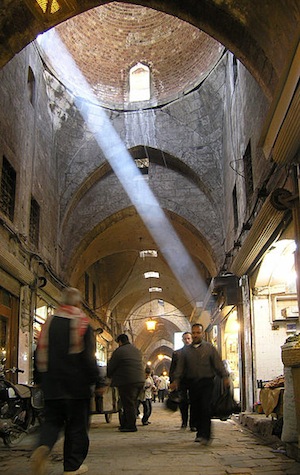
Historical "monuments" being destroyed before our very eyes


We are all, in effect, silent witnesses to the destruction of history!

"Thirty thousand people have died in Syria's civil war—and the killing is only intensifying. Obviously, human beings are any war's most appalling casualties, but there are cultural conflagrations that matter, too—vital spaces laid waste, lost forever. Few alive today have experienced the reputed grandeur of old Warsaw, leveled by Nazi bombs in World War II. How would the celebrated Aztec city of Tenochtitlán have weathered the centuries? We'll never know, because the Spanish flattened it in the process of conquest, building over it what we now know as Mexico City.

Unhappily, the violence in Syria has spread to the "ancient city" section of Aleppo, a UNESCO World Heritage site and home to the famous Souk Madina, a vast market vending everything from meat to spices to fabric since medieval times. On Saturday, reports Reuters, a clash between government and rebel forces sparked a fire that swept through the old market, burning a substantial portion of it. According to Reuters, it's the largest covered market in the world—"a network of vaulted stone alleyways and carved wooden facades" whose winding interior hallways "have a combined length of eight miles."

The extent of the damage remains unclear, but it appears extensive. Reuters reports that local observers say at least 1,500 stalls are ruined, and were, as of Sunday, still burning. UNESCO Director-General Irina Bokova has issued a missive deploring the destruction. "The Aleppo souks have been a thriving part of Syria’s economic and social life since the city's beginnings. They stand as testimony to Aleppo’s importance as a cultural crossroads since the second millennium B.C.," she wrote. I have emails into the UNESCO press office seeking an update on the damage."


Comments

Popular posts from this blog

The Pentagon's eye-popping spending....and waste!

Only a gigantic bureaucracy could get away with spending of such dimensions - and the amazing waste involved in part of that ginormous spend.   Think US Pentagon..... "From spending $150 million on private villas for a handful of personnel in Afghanistan to blowing $2.7 billion on an air surveillance balloon that doesn’t work, the latest revelations of waste at the Pentagon are just the most recent howlers in a long line of similar stories stretching back at least five decades.  Other hot-off-the-presses examples would include the Army’s purchase of helicopter gears worth $500 each for $8,000 each and the accumulation of billions of dollars' worth of weapons components that will never be used. And then there’s the one that would have to be everyone’s favorite Pentagon waste story: the spending of $50,000 to investigate the bomb-detecting capabilities of African elephants. (And here’s a shock: they didn’t turn out to be that great!) The elephant research, of course, represe...

Video: Israel demolishing a Bedouin village

From Mondoweiss - Israel's supposed "most moral army in the world", the IDF, engaged in immoral, and according to international law, illegal action.... "Israeli forces have demolished every home in the Bedouin village of Khirbet Taha in the northern West Bank district of Nablus during three separate demolitions since the start of the year. Unlike most Bedouin villages, the residents in Khirbet Taha own their own land. However that land falls in Area C, territory in the occupied West Bank under full Israeli control. The village’s only school was also destroyed, leaving children to study in a dilapidated 100-year-old mosque — the only structure left standing in the village. According the United Nations, Israel has demolished half as many Palestinian buildings in the first few months of 2016, as they had in all of 2015. In February alone, the UN found that more Palestinians homes were destroyed than any other month since 2009, when the organization began its docum...

What does a no-fly zone actually mean?

As some countries consider imposing a no-fly zone in relation to Libya, the pertinent question must be what does that mean and entail? FP provides the answers: "It depends on the circumstances. There are two primary types of no-fly zones imposed by air forces. The first is imposed by one military over another, while the two sides are at war. In practice, this type of no-fly zone amounts to a warning from one side that it will engage the other's aircraft if they are spotted in a given territory. The second type, more applicable to the situation in Libya, is when an outside power possessing overwhelming air superiority restricts flights over a given country in order to discourage an internal conflict or humanitarian crisis. This is a relatively recent tactic, which was used most famously in Bosnia and Iraq during the 1990s. No-fly zones are often a compromise in situations where the international community is demanding a response to ongoing violence, but full military interven...